
Guide
What That Sound Coming From Your Garage Door Actually Means
Grinding, popping, or a slow thud on the way down - Temecula's 1980s-era door hardware makes specific sounds. Here's what each one is actually telling you.
Local detail
The Cost of This Job
There's no flat number for this because the noise itself tells you what part is failing, and that changes the bill. A dry hinge squeak is a five-minute lube job. A rhythmic thud on the way down, on the other hand, usually means a roller has flat-spotted or a section of track has shifted, and on a door built in the mid-1980s - which describes most of the housing stock in this service area - that track might not match anything sold today.
We won't quote a price over the phone without seeing the door, because a spring that sounds like it's grinding could be one bad bearing or it could be a spring at the end of its cycle life on original 1980s hardware, and those are two very different jobs. What we can tell you is that a lot of the calls we take in houses from that era end up being a hardware swap rather than a full door replacement, because the panels themselves have usually held up fine - it's the moving parts that give out first. If your door is newer, built anywhere in the 1990s-2009 range that's common on the newer side of town, the same noise usually points to something simpler, like a loose fastener rather than worn steel.
The area
The Seasonal Bit
This is the section where a lot of garage door advice gets padded out with talk of freeze-thaw cycles and winter spring failures, and none of that applies here. Temecula sits in a mild temperate band - no hard freezes, no deep cold snaps that shrink steel and snap a fatigued spring overnight the way you'd see in a harsher climate. That's the honest limitation on this section: we don't get a predictable seasonal spike in emergency calls tied to weather the way companies in colder regions do.
What we do see instead is noise that builds slowly over years of cycles rather than showing up suddenly with a cold front. A spring that's been opening and closing a door for three decades wears out from use, not from a January freeze. So if your door has gotten louder over the past year with no obvious trigger, that's not seasonal - that's just the part reaching the end of its working life. Track that against how old your specific opener and spring setup are rather than waiting for a season to blame it on.
What we find
How Local Conditions Play In
Housing here runs from 1975 through 2009, with the median landing around 1984, and most of what we work on across the twenty communities we cover - from Rainbow six miles out, through French Valley, Fallbrook, and Pala at eight to ten miles, out to Wildomar, Sage, Canyon Lake, and as far as East Hemet at twenty miles - falls into that 1980s-to-90s stock band.
What that means for noise: a lot of these doors still run original torsion hardware that was standard for that build era, and original hardware wears differently than anything installed in the last ten years. Steel rollers instead of nylon, single-spring setups on doors that would get double springs today, openers with gear sets that grind audibly months before they fail outright. None of that is a defect - it's just what was normal when the house went up. Knowing roughly when your section of the area was built gives us a starting guess on what's inside the header before we even open the panel, which speeds up the actual diagnosis on-site.
How we work
What Is Going On
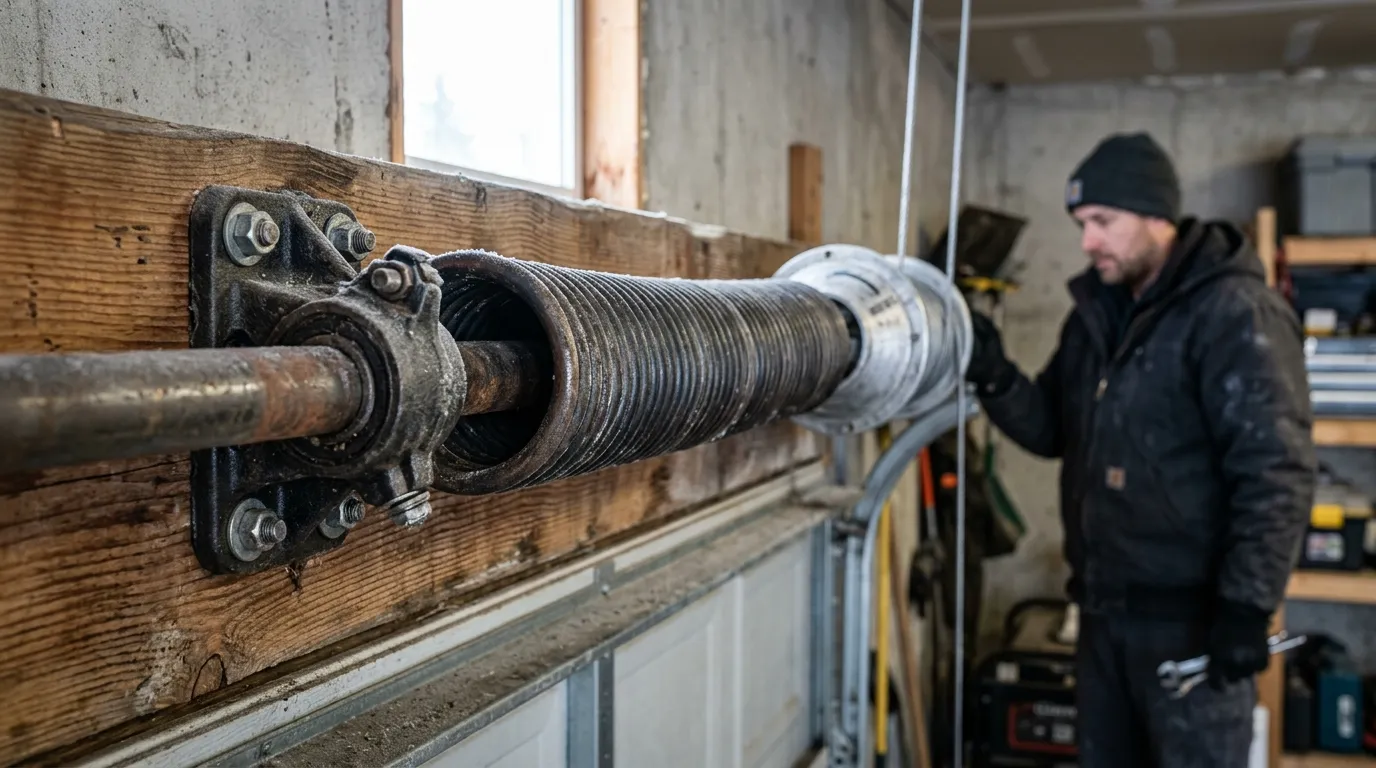
Break the common noises down by what they usually mean, given what's actually installed in houses of this age around here. A sharp bang followed by the door refusing to move is almost always a broken torsion spring - common on original hardware from the 1980s that's simply reached its cycle limit. A rattling hum that gets louder as the door travels usually points to worn rollers, especially the steel ones that shipped standard on doors from that era before nylon became typical.
A grinding sound from the motor unit, distinct from the door itself, usually means the opener's gear is wearing down - and on units original to a house built in the mid-1980s, that gear has likely outlived its expected life already. A slow, low creak on the way up, versus a sudden snap, tells you the difference between a hinge that needs lube and a cable starting to fray. None of these require guesswork over the phone, but knowing the sound in advance helps us bring the right part instead of a guess.
Questions
Common questions
My door makes a loud bang and won't open at all - what is that?
That's almost always a broken torsion spring, and it's common on original hardware in houses from the 1980s that have simply reached the end of their cycle life. Don't try to force the door open manually - the other spring, if there is one, may also be near failure. This is a same-visit fix once we're on site.
Is a grinding noise from the motor different from a grinding noise from the door?
Yes, and it matters. Grinding from the unit mounted on the ceiling usually means the opener's internal gear is wearing out, common on units original to older builds. Grinding from the door track itself usually means a roller has gone bad. We can often tell which from a phone description, but confirm on-site.
Do I need a whole new door if it's making noise?
Not usually. Most of what we see on houses from the 1975-2009 era around here turns out to be a hardware issue - spring, roller, or opener gear - rather than a problem with the panels themselves. We'll tell you honestly if replacement makes more sense than repair, but that's the exception, not the rule.
Ready when you are
Need a garage door sorted in Temecula?
Temecula Garage Door Pros repairs and installs garage doors, springs and openers in Temecula, CA and the surrounding area.